Data Center Decommissioning | Excess IT Hardware

Liquidate infrastructure without disrupting operations

Data Center Decommissioning Services from Excess IT

Data center decommissioning is not a normal equipment pickup. It is a high-stakes project where time, security, and documentation all matter at once. One missed serial number, one unmanaged drive, or one poorly planned removal can create downtime, compliance issues, and expensive rework.


Excess IT Hardware provides data center decommissioning and data center clean-outs throughout the United States and across the globe, helping organizations remove infrastructure safely and efficiently while keeping control of the process from start to finish.

Excess IT Hardware team member scans a shrink-wrapped pallet of computer equipment with a handheld barcode scanner in a warehouse.

The real challenge is not the equipment. It is the process.

Most data centers contain mixed equipment types, different ownership statuses, and multiple stakeholders. You might be retiring a facility due to cloud migration, consolidating sites after a merger, or clearing a colocation footprint on a deadline. In every scenario, the hardest part is coordination.


Excess IT Hardware positions data center decommissioning as one of the most complex forms of liquidation because it involves racks, mixed hardware types, time-sensitive scheduling, and high-security requirements.
That complexity is exactly why a defined workflow matters: controlled removal, tracked handling, data security steps, and final reporting that closes the loop.

What Excess IT Hardware removes and manages

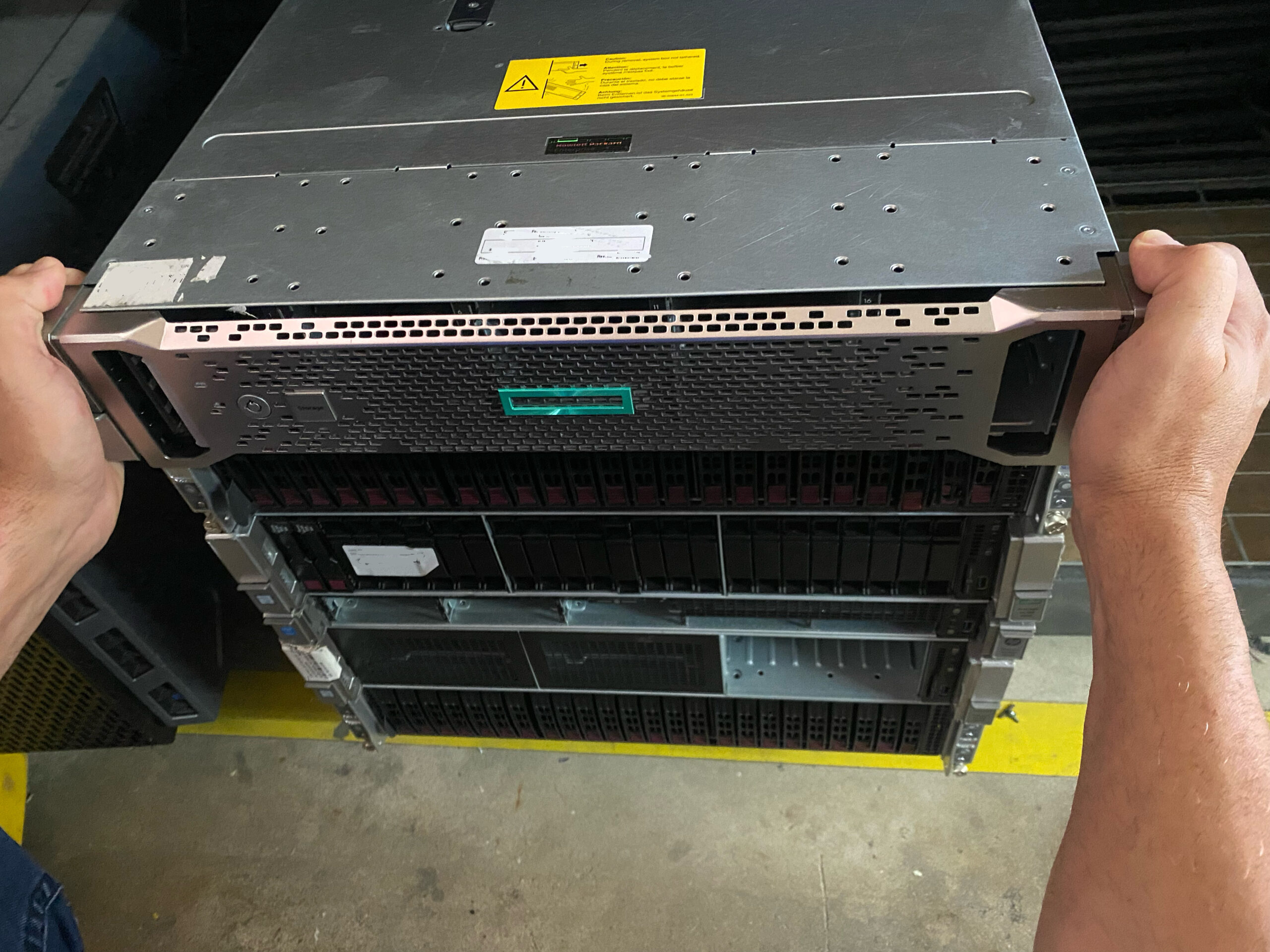
Data center projects rarely include only servers. Your site may include legacy platforms, specialized infrastructure, and heavy equipment that requires experience to remove correctly. Excess IT Hardware states its team can remove mainframes, battery back-ups, and tape decks from data centers, telecommunication hubs, and corporate data farms throughout the United States and abroad. This supports a full clean-out approach instead of a partial removal that leaves you coordinating multiple vendors.

Pile of discarded computers and electronic equipment awaiting proper recycling and disposal.

A decommissioning workflow built for security and documentation

How you reduce risk and speed up closeout

A successful decommissioning project is measured by two outcomes: nothing gets missed and nothing becomes a security problem later.


Excess IT Hardware highlights chain-of-custody handling and documentation to support business compliance, along with support for sorting, secure processing, and final reporting for large loads. That is the foundation of an enterprise-ready decommissioning workflow: clear handling from pickup through processing, then documented results your team can file. If value recovery is part of your plan, the project can also connect to liquidation services that support evaluation, channel selection, and equipment pathways that reduce waste and recover ROI where appropriate.

Container filled with shredded hard drive pieces from on-site hard drive shredding service.

Why organizations choose professional decommissioning

Faster timelines, lower exposure, better outcomes

Decommissioning is often triggered by a deadline. Lease expirations, colocation contract changes, or refresh schedules do not wait. A structured partner helps you avoid common failure points like unclear staging, incomplete inventory, or inconsistent data handling. Professional decommissioning supports:

Operational continuity by planning removal around your environmentBetter governance through chain of custody and controlled handling
Improved audit readiness through final reporting and documented project outcomes


Cleaner sustainability outcomes by routing what can be recovered or recycled responsibly

Nationwide service and nationwide pickup

South Florida core service with nationwide coverage

Excess IT Hardware provides nationwide service and nationwide pick up across South Florida and outside South Florida, including outside South Florida repair service where applicable. This helps multi-location organizations standardize one decommissioning process, one documentation style, and one vendor relationship, even when equipment is spread across multiple states.

At the end of every project, location should never be a limitation.

The Outcomes You Get From Excess IT Hardware

Security, compliance, and sustainability, with documentation.

This is what clients want after an e-waste pickup. This is also what decision-makers need to sign off.

Audit-ready documentation
We issue a certificate of recycling and data security for hardware processed. 

Lower chain-of-custody uncertainty
Your organization should not have to guess where equipment ends up. Strong programs reduce chain-of-custody risk by combining tracking, controlled processing, and documentation. 

A sustainability story you can defend
A reuse-first approach and responsible downstream processing support corporate sustainability goals and reduce landfill impact. 

Optional value recovery
If equipment still has value, remarketing or asset recovery paths can offset program cost and reduce waste.

Positive impact options
If your program includes donations or community impact goals, we can align your recycling program with initiatives that support positive outcomes.

How Our E-Waste Recycling Process Works

Simple steps, clear handoffs, documented results

  • Top-ranking recycling service pages tend to follow a clear step structure like schedule, pickup, processing, and reporting. We recommend the same, with stronger clarity and trust signals. 
  • Step 1: Tell us what you have
    Share your location, estimated volume, and device types. If you have data-bearing assets, tell us your policy requirements.
  • Step 2: Schedule pickup and logistics
    We coordinate pickup and confirm what is needed for safe transport and processing.
  • Step 3: Intake, inventory, and secure handling
    Assets are scanned into inventory and data-bearing media is addressed as part of the workflow. 
  • Step 4: Reuse, test, and disposition routing
    Resalable equipment is evaluated. Non-working assets move to disassembly and material recovery. 
  • Step 5: Responsible recycling and downstream processing
    Materials are separated and routed to R2 downstream processors consistent with a zero-landfill policy. 
  • Step 6: Reporting and certificates
    You receive documentation, including a certificate of recycling and data security for processed hardware. 

FAQs About Data Center Decommissioning

What is included in data center decommissioning, and is it the same as ITAD?

Data center decommissioning typically includes planning the removal, securing and handling equipment, and completing disposition steps like data security processing, asset recovery, and recycling. It overlaps with ITAD, but decommissioning is broader because it often includes racks, mixed hardware types, heavy infrastructure, and time-sensitive scheduling. Excess IT Hardware describes data center decommissioning as a complex liquidation service due to mixed hardware types, tight timelines, and high-security requirements.

Yes. Excess IT Hardware states its team can remove mainframes, battery back-ups, and tape decks from data centers and similar facilities. This matters because data centers usually include legacy and supporting infrastructure that still needs a safe, documented exit plan.

Start with a plan that identifies what is live versus what is retired, then stage removals in phases around your operational needs. The best projects use clear scheduling, controlled handling, and documented removal so teams are not guessing what was moved. Excess IT Hardware positions decommissioning as time-sensitive and security-sensitive, which is why planning and process control are critical.

You should expect documentation that helps your team close the project with confidence, such as reporting tied to what was collected and what happened after processing. Excess IT Hardware notes it supports chain-of-custody handling and provides documentation and final reporting for large loads. If you need serial-level reconciliation, build that requirement into the scope so reporting matches your internal asset list.

Retired equipment is typically sorted into pathways such as asset recovery, reuse, or responsible recycling based on condition, policy, and value. The important part is that the pathway is documented and security steps are applied consistently. Excess IT Hardware supports secure processing and final reporting, helping organizations track outcomes instead of relying on assumptions.

Ready to Decommission With Confidence

If you are closing a site, consolidating racks, or clearing a data center footprint on a deadline, Excess IT Hardware can help you plan, remove, and close out the project with a secure process and documented results. Schedule a pickup to start a data center decommissioning workflow that protects uptime, reduces liability, and recovers value where possible.


Visit Excess IT Hardware and Contact us today to request a quote or schedule computer disposal pickup.