ITAD Process and Compliance Built for Audits, Not Checklists

A 6-stage workflow with serialized chain of custody, NIST 800-88 sanitization, and closeout documentation that survives an auditor's review.

Most Compliance Failures Live in the Gaps Between Vendors

Retired IT equipment is not harmless when it is unplugged. Servers still hold credentials. Laptops still hold customer records. Mobile devices still hold session tokens. The biggest risk is rarely the technology itself. The risk lives in the gaps between pickup and processing, between vendors, and between the documentation your IT team produces and what your auditor or regulator actually expects to see.

Process and compliance is the discipline of closing those gaps before they become incidents. Excess IT Hardware built its compliance program around a 6-stage workflow that produces a defensible audit trail at every stage, with no documentation gaps and no “trust us” handoffs.

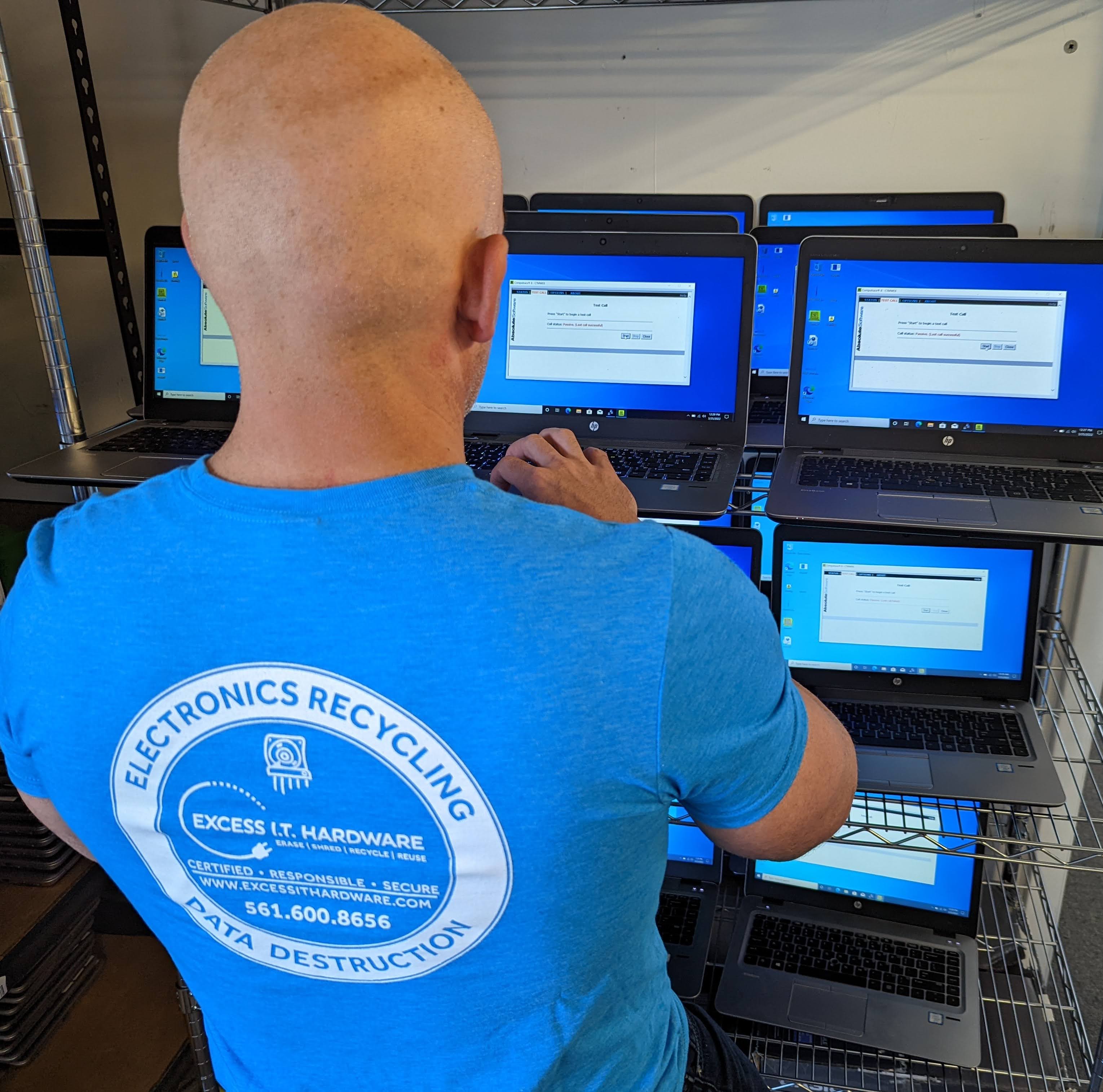
Excess IT Hardware team member standing beside a branded service truck.

The 6-Stage Compliance Workflow That Holds Up Under Audit

Most IT disposal vendors describe their work in vague terms: “secure pickup,” “certified destruction,” “responsible recycling.” Auditors do not accept vague. They accept evidence. The Excess IT Hardware 6-stage workflow produces a documented evidence trail at every stage.

#

Stage

What Happens

Evidence Produced

1

Intake & Project Scoping

We confirm equipment categories, pickup locations, data security level, regulatory framework, and required destruction methods before any asset is touched.

Signed scope of work, pickup manifest, regulatory framework checklist

2

Controlled Pickup & Chain of Custody

Equipment is collected by background-checked staff in identifiable vehicles. Assets are scanned by serial number or asset tag at pickup and sealed under signed transfer.

Serialized pickup manifest, custody transfer signatures, GPS-tracked transport log

3

Data Sanitization or Destruction

Each drive is sanitized to NIST 800-88 (Clear, Purge, or Destroy) based on your policy. Drives requiring destruction are shredded or crushed to certified specifications.

NIST 800-88 method log, drive-level sanitization report, destruction witness record

4

Asset Tracking & Inventory Reconciliation

The pickup manifest is reconciled line-by-line against the destruction or remarketing log. Discrepancies are flagged and resolved before closeout.

Reconciliation report, exception log, asset disposition outcome record

5

Documented Closeout

You receive a serialized certificate of recycling and data security covering every asset by serial number, plus method-level destruction certificates where applicable.

Serialized certificate of recycling and data security, destruction certificates, signed closeout package

6

ESG & Audit Reporting

Closeout data is summarized for your ESG report, internal audit, vendor risk review, or regulator disclosure with weight-diversion, reuse, and sanitization metrics.

ESG impact summary, audit-ready disposition report, weight diversion data

The Frameworks This Workflow Was Designed Around

The 6-stage workflow is not a marketing artifact. It is mapped to the documentation and process expectations of the regulatory frameworks our clients operate under:

  • HIPAA (45 CFR §164.310(d)(2)) for healthcare providers, business associates, and covered entities retiring systems containing protected health information
  • SOC 2 Type II for service organizations whose disposal practices are reviewed under the Security and Confidentiality trust services criteria
  • ISO 27001 / 27002 for organizations managing an Information Security Management System (ISMS) with formal asset disposal controls
  • GLBA Safeguards Rule for financial institutions disposing customer information systems
  • PCI DSS Requirement 9.8 for any media containing cardholder data that has reached end-of-life
  • NIST SP 800-88 Rev. 1 for federal agencies, federal contractors, and any organization aligning sanitization to the federal media sanitization guidance
  • State data laws including California CCPA, New York SHIELD Act, Texas DPSL, and Florida FIPA destruction provisions

How to Tell If Your Current ITAD Program Will Survive an Audit

If your organization is preparing for a HIPAA audit, a SOC 2 review, an ISO 27001 certification, a regulator request, or a vendor risk assessment, run this audit-readiness scorecard against your current ITAD program. Every “no” is a documented gap.

Audit-Readiness Question

Excess IT Answer

Can you produce a serial-level inventory of every asset disposed in the last 12 months?

Yes — serialized in every project

Can you show which sanitization method (Clear, Purge, or Destroy under NIST 800-88) was applied to each drive?

Yes — method log per drive

Can you reconcile the pickup manifest against the final destruction or remarketing log?

Yes — Stage 4 reconciliation

Do you have signed chain-of-custody documentation from the original pickup?

Yes — Stage 2 transfer signatures

Can you document downstream recycling outcomes consistent with EPA guidance?

Yes — Stage 6 ESG reporting

Can you produce all of the above within 24 hours of an audit request?

Yes — closeout package is delivered at project end and retained

If your current vendor cannot answer “yes” to all six, your program has audit-readiness gaps. Excess IT Hardware was built specifically to close those gaps. Review the documentation we issue on our certificate of recycling and data security page.

Why a Compliance-First Process Speeds Up Approvals Instead of Slowing Them Down

Many IT teams treat compliance as the thing that slows projects down. The opposite is true when the workflow is right. A documented process means fewer back-and-forth questions from legal, faster sign-off from finance on disposition value, and a closeout package that closes the project instead of triggering follow-up requests. Process and compliance done right does not add friction. It removes it.

Who Uses This Process Most

The 6-stage workflow was built for organizations where IT disposal exposure is measurable: healthcare systems and clinical practices, financial services and credit unions, law firms and legal-services providers, federal contractors and state government vendors, K-12 districts and higher education institutions, and any fast-growing organization where IT turnover is high enough that documentation gaps compound quickly.

If your team has ever asked, “do we have proof of what happened to that equipment?” or “can we produce that report by Friday?” this workflow exists for that question. For organizations bundling compliance into a broader IT lifecycle program, the workflow integrates with our IT asset disposition (ITAD) service and our electronics e-waste recycling hub.

Nationwide Service and Nationwide Pickup

Excess IT Hardware is headquartered in West Palm Beach, FL, and operates the 6-stage compliance workflow nationwide. Whether your project is a single office in Boca Raton or a multi-state enterprise rollout, the workflow stays consistent: same intake, same chain of custody, same documentation standard, same closeout package. Multi-location organizations get a single point of accountability across all sites instead of stitching together documentation from a patchwork of regional vendors.

Stop Hoping the Documentation Is Right. Make Sure It Is.

Compliance failures are almost never about technology. They are about documentation that does not exist when an auditor asks for it. The 6-stage workflow exists so that question never becomes a problem. Every stage produces evidence. Every project closes with a defensible package. Every audit gets the answer it needs without scrambling.

Two ways to start: Request a compliance-ready pickup online or call (561) 600-8656 to scope your project with a specialist.

FAQs About Process and Compliance

What does chain of custody mean in IT asset disposition, and what documentation should I expect?

Chain of custody in ITAD is the documented control of every asset from the moment it leaves your physical custody to the moment it reaches its final disposition outcome (recycled, destroyed, or remarketed). It matters because the gap between pickup and processing is where most compliance failures happen. A meaningful chain of custody includes a serialized pickup manifest signed at the time of collection, transfer documentation between every party that handles the equipment, GPS or tracking data for the transport leg, intake confirmation at the processing facility, and reconciliation between what was picked up and what was processed. Excess IT Hardware produces this documentation as part of the standard project closeout package, not as an upsell. If your current vendor only provides a pickup receipt and a generic certificate, you have a chain-of-custody gap that an auditor will find.

Audit-grade documentation is project-specific, not generic. Auditors expect to see paperwork that ties directly back to assets and outcomes you can verify. For a SOC 2 review, that typically means a signed scope of work, a serialized inventory of disposed assets, evidence of sanitization or destruction method per drive, and a closeout certificate that uniquely identifies the project. For a HIPAA audit, the same elements apply with extra emphasis on documentation that tracks PHI-bearing devices specifically and confirms that sanitization or destruction met the standard required by your internal policy. Generic vendor logos on a one-page certificate do not pass either review. Excess IT Hardware issues serialized documentation by default so the closeout package is the audit package.

The decision should be driven by three factors: your internal policy, the sensitivity of data on the device, and whether the device has residual value. Software-based data erasure aligned to NIST 800-88 Purge is appropriate when the drive is in good working order, when residual value recovery is part of the project goal, and when your internal policy does not require physical destruction. Physical destruction (shredding or crushing) is appropriate when the drive is end-of-life, when the data was highly sensitive (such as encryption keys, root credentials, or healthcare records under stricter internal policy), when sanitization verification fails, or when your policy explicitly requires irreversible destruction. Excess IT Hardware supports both paths and routes each device based on the rules you set, not a one-size-fits-all default.

Yes, and most organizations under-report what their ITAD program actually contributes to ESG. A documented disposition program produces measurable outcomes: pounds of e-waste diverted from landfill through reuse or recycling, units returned to circulation through remarketing, components recovered through certified downstream processing, and reduced scope 3 emissions tied to manufacturing replacement equipment. The Stage 6 reporting in the Excess IT 6-stage workflow specifically packages this data so it can be dropped into your ESG report, sustainability disclosure, or annual impact statement without manual reconciliation. If your ESG team has been asking IT for disposition data and IT has been struggling to produce it, this is the gap that gets closed.

Three things make a compliant pickup go smoothly. First, give your ITAD vendor a pre-pickup inventory of everything you intend to dispose of, including approximate counts, equipment categories, and any items containing regulated data (PHI, PCI, or highly sensitive intellectual property). Second, identify a single point of contact at your facility who has authority to sign chain-of-custody documentation at pickup, because a signature from someone without authorization can create downstream documentation problems. Third, decide your sanitization policy in advance: which devices require physical destruction, which can be wiped for resale, and what your default is for devices the policy does not specifically address. Excess IT Hardware can guide each of these conversations during Stage 1 (Intake and Project Scoping) so the pickup itself is fast, documented, and doesn’t disrupt your operations.

Get a Process You Can Stand Behind

If your organization needs a repeatable ITAD workflow with compliance built in, Excess IT Hardware can help you move from uncertainty to documented control. Contact our team to align pickup logistics, data security requirements, tracking needs, and documentation expectations so your next project closes out cleanly and confidently.

Visit Excess IT Hardware and Contact us today to request a quote or schedule computer disposal pickup.